
The Marrying Up Trap
The dating advice nobody gives you

Growing up, my mom always told me to marry up. “Find someone better than you,” she’d say.
I spent many years on the dating market, ambitious, picky, and often oblivious. I never thought of myself as materialistic. My dating philosophy was simple: If I’m going to marry someone I love, why can’t he also be successful?
Women have long been encouraged to seek partners with higher social and economic status. From the marriage plots of Pride and Prejudice to modern-day dating apps, “marrying up” has been the gold standard for single women seeking a spouse. But in today’s world, where women now outpace men in education and increasingly in earnings, it is mathematically impossible for all women to marry up.
There's a popular folk theory about the dating market in China. The idea is that when all women want to marry up, the "top" single women and "bottom" single men are the ones most likely to be left out of the marriage market. I illustrate this below, based on the socioeconomic status of single men and women.
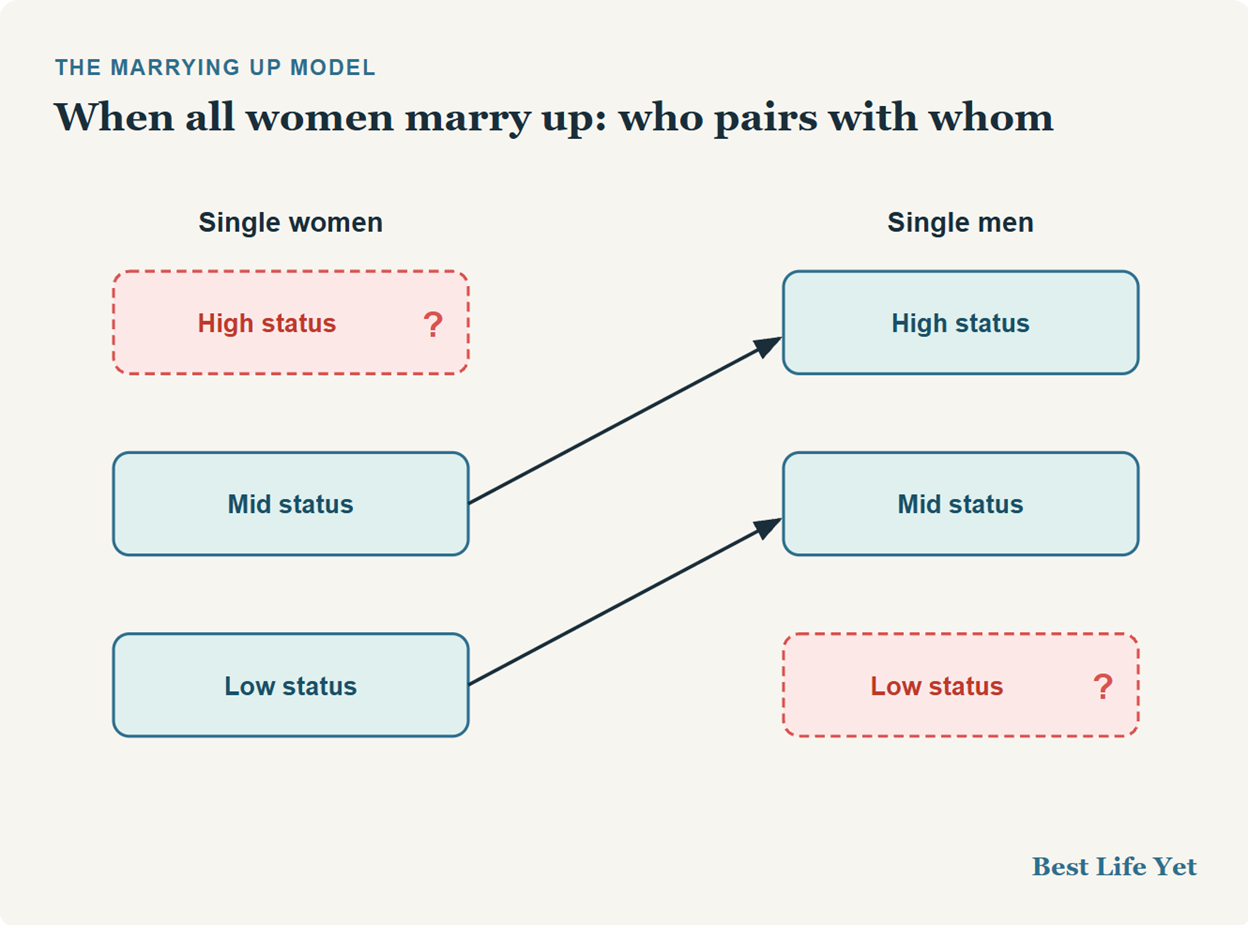
The logic is simple: If every woman wants a man of higher status, someone gets left without a match. This pattern holds in the U.S. too. A large body of research shows a mismatch between what women want and the pool of available men. A recent paper by Dan Lichter and colleagues titled “Mismatches in the Marriage Market” provides clear evidence: There is a shortage of economically attractive unmarried men but a surplus of unmarried men with low income and education.
To demonstrate this, they built a “synthetic husband” profile for unmarried women based on the characteristics of married women’s actual husbands. Let’s call these synthetic men the ideal husbands. The ideal husbands earn about 58% more than the pool of unmarried men who are actually available, and they are also more likely to be employed and hold a college degree.
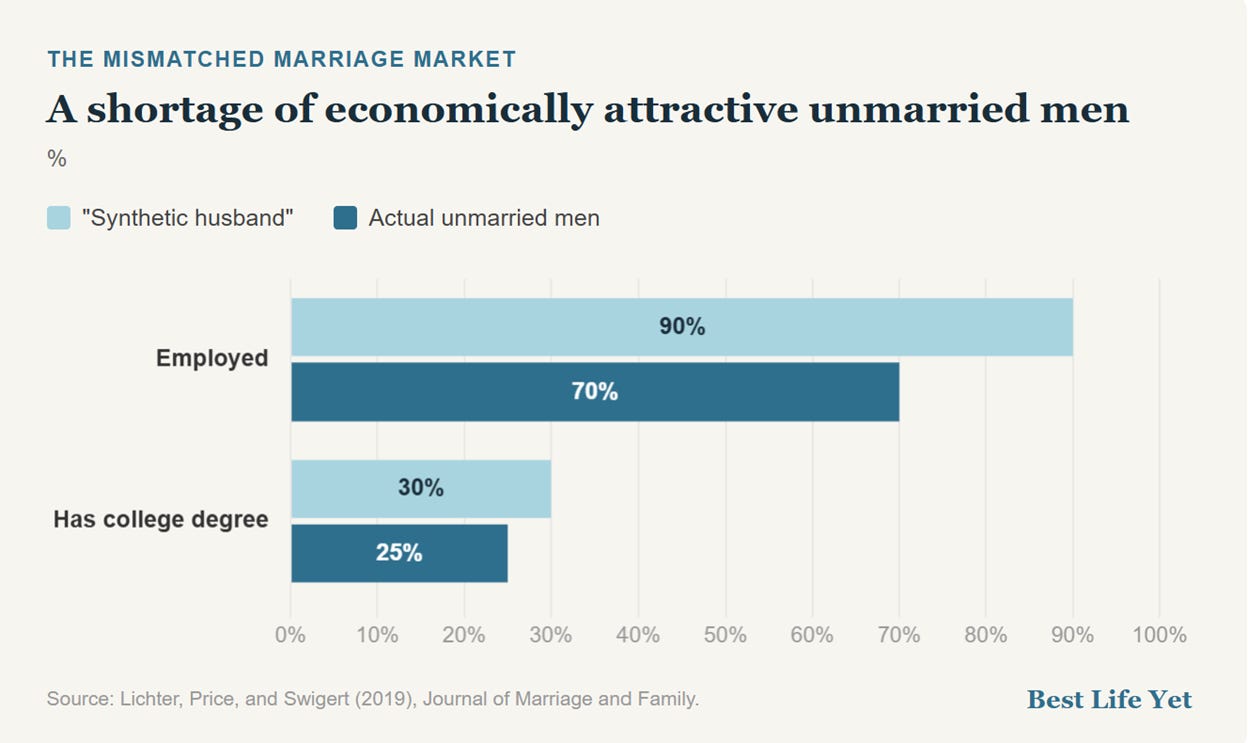
The paper also finds that younger women and less‑educated women have more potentially suitable partners available to them. But older and highly educated women face the steepest shortages of potential partners.
My own research, which the paper cites, shows something similar: Never‑married women place a much higher premium on finding a spouse with a steady job than never‑married men do, even as the pool of employed young men has been shrinking.
The mismatch is clear. There simply aren’t enough single men for single women to marry up. If women want to marry, someone has to marry an equal or marry down.
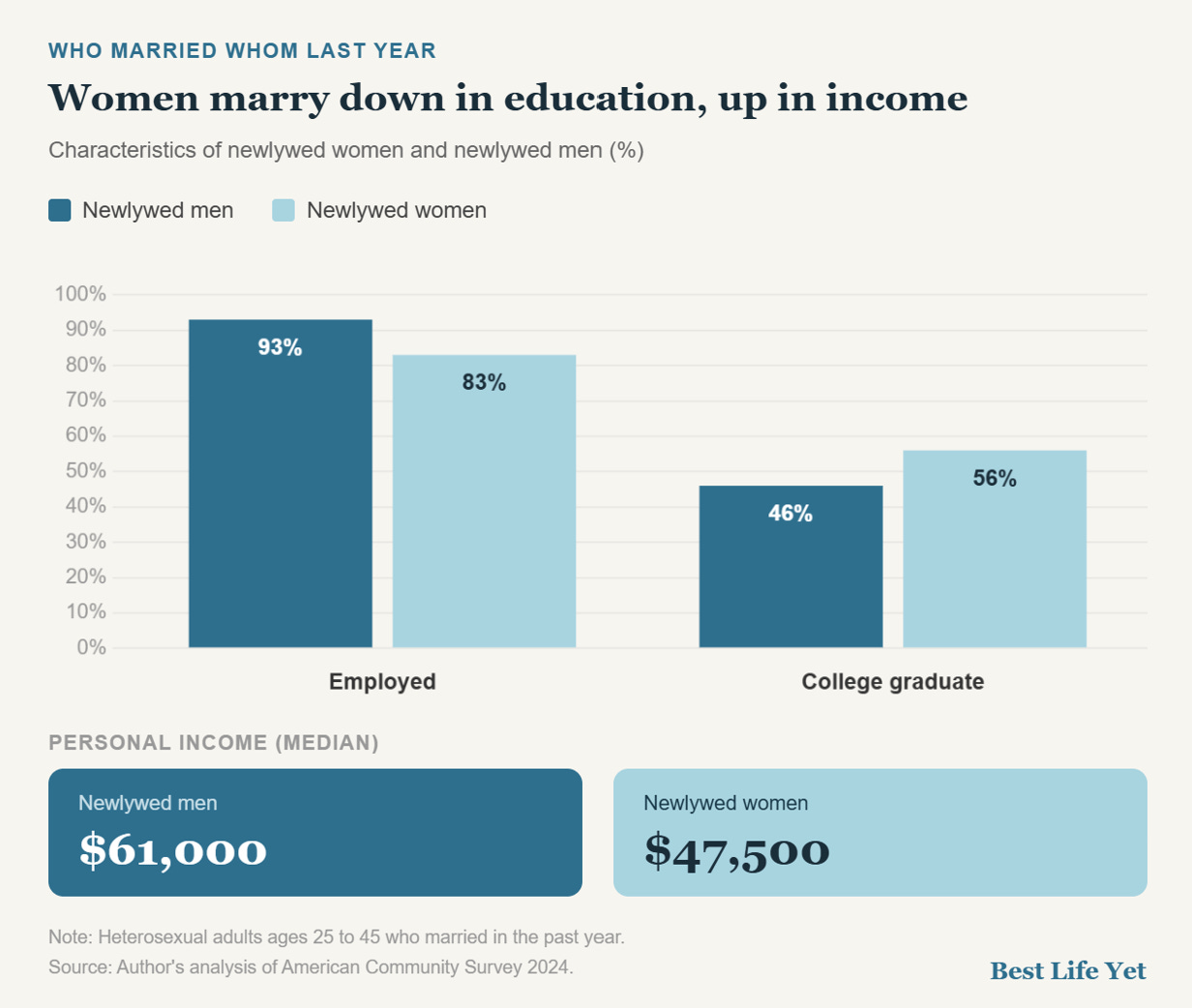
And in reality, that’s already happening. In nearly half of U.S. marriages today, women earn as much as or more than their husbands. And when it comes to education, it’s increasingly men who are marrying up these days.1
I hope knowing this gives some relief to ambitious young women in the dating world who feel frustrated.
I know the feeling, because I was one of them.
Thanks to the dating websites (there were no apps yet), I met my share of successful, ambitious men — lawyers, doctors, business executives. The old joke, “If you throw a stone in DC, you’ll hit a lawyer,” felt true enough.
A friend once invited me to a young‑adult retreat on dating and relationships. I didn’t bother going. There’s nothing wrong with me, I thought. I just hadn’t met the right one yet.
If I could go back and talk to my younger self, I’d say: “You idiot. You absolutely need relationship education!”
In the end, I didn’t marry up, as my mom had hoped. But after twelve years of marriage, I can tell you with confidence: Not only does the math of “marrying up” fail, but the mindset also misses what marriage is really about.
Marriage is a commitment two people make to build a life together. It is neither a prize nor a destination. It’s the beginning of a journey you walk side by side, and perhaps with the family you two create along the way.
Falling in love is wonderful, but it’s not what sustains a marriage. The success of marriage depends on commitment: The willingness to tolerate each other, bear each other’s burdens, and serve each other, day after day.
The person who looks like a great catch, with money, status, or an impressive title, may not have the skills to live an everyday life with you. You’re choosing a partner to live a life with, not someone with a fancy resume.
The sooner you understand this, the better off you’ll be in finding the right person to marry — whether you end up marrying up, down, or sideways.
Author’s note: If you are interested in the broader question of why fewer Americans are getting married and having kids, check out my article on the IFS website. In it, I make the case for the unique advantages of marrying young for modern women.
Regarding the pattern of women marrying up in income and men marrying up in education, my latest analysis shows that the education gap seems to be widening, but newlywed men still earn more on average.
I was not ambitious as a single male. I married up and my wife always made more than me until our 3 child. I finally passed her income enough for her to stay home full time. Having a wife and children I loved naturally drove me to succeed and I feel more fulfilled for it and would now consider myself an high status male in my self forged career despite hot having a college degree like my wife. I believe a good number of those low status males would significantly improve their status if they were able to get married to someone that loved them.
You aren't just getting married to a person, you are marrying _into a family_. Thus, your spouse's siblings and parents will have a role to play in your future financial security (and happiness), especially if you definitely want children.
A husband who has proximate parents who will be active grandparents to your children may be financially "worth" more than a husband whose income is higher, but whose parents don't live nearby and/or would be much less involved in their grandchildren's lives. Indeed, there is a measurable "grandparent effect" where people living near to their parents have more children, and that's plausibly due to grandparental support for the grandchildren.
If you like international travel, maybe it's better to have a husband whose family lives nearby, rather than one whose family lives in distant places, since you might have to "sacrifice" vacations to visit your husband's parents if they don't live nearby.
Nobody likes to talk about this, but a spouse whose parents have money, might also be "worth" more financially than a higher income spouse whose parents don't have money. 72% of Gen Xers get money from their parents, so it's not so rare. Maybe your spouse's parents won't give you money directly, but they'll open 529s for your children and indirectly take financial pressure off of you.
So I agree, people, especially women, even if they are being totally pragmatic and non-romantic, should consider financial factors other than their potential partner's income. It also matters where your potential spouse's parents live, their attitudes towards you and future grandchildren, and how much money they have.